
What are major meatpackers, soy traders, and retail chains in Brazil doing to eliminate deforestation and vegetation conversion from their supply chains? To answer this question, Mighty Earth partnered with IDEC (Brazilian Institute for Consumer Protection) to assess how these companies are implementing their DCF commitments.
DEFORESTATION- AND CONVERSION-FREE (DCF) ASSESSMENT
What are DCF commitments?
Deforestation- and Conversion-Free (DCF) commitments are corporate policies aimed at eliminating deforestation and the conversion of natural ecosystems, such as the Amazon, Pantanal, and Cerrado from soy and beef supply chains.
These commitments typically include cut-off dates for implementation, traceability requirements, monitoring of production systems, and mechanisms to exclude non-compliant suppliers. When effectively implemented, these policies are key tools for protecting forests and the rights of Indigenous and traditional communities.
However, the strength of these commitments depends not only on their scope, but on how they are applied in practice — making transparency, monitoring, and corporate accountability essential.
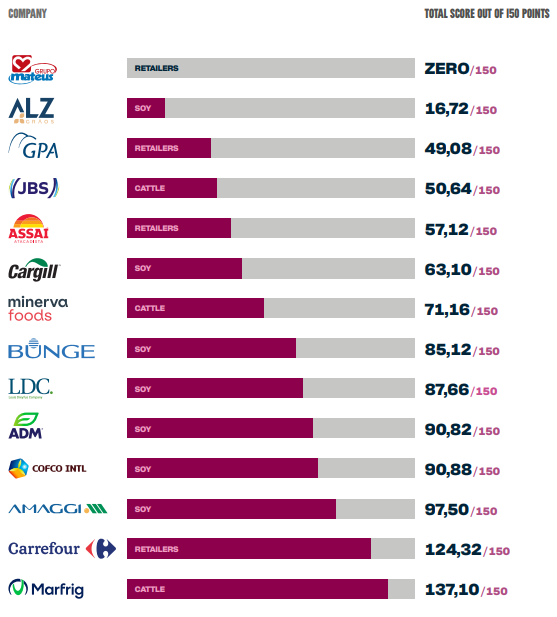
We analyzed 14 key companies – 3 meatpackers, 4 retailers, and 7 soy traders – to understand how they are addressing the exposure of their supply chains to deforestation and biome conversion. The results are published in the report “No ‘zero’, just deforestation.”
The conclusion is that there is a clear gap between the commitments made and their implementation in practice.
Together, these tools provide a comprehensive view of risk, accountability, and progress toward deforestation- and conversion-free supply chains.

